
Visit to Hoover Dam
FluidPower d.o.o. – August 26, 2026
An Engineering Perspective on One of the Most Significant Hydropower Facilities in the United States
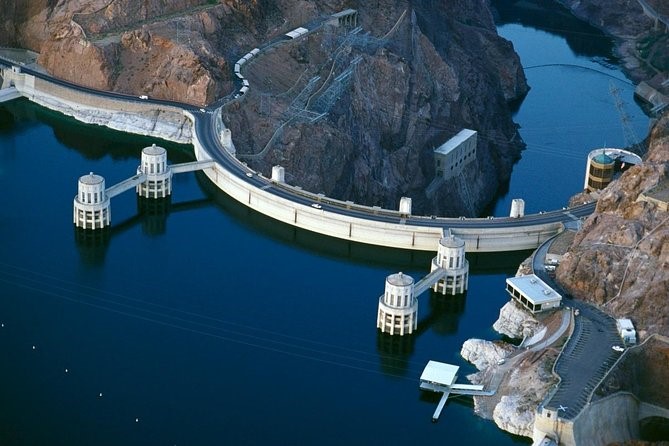
On August 26, 2026, a representative of FluidPower d.o.o. visited the Hoover Dam complex, one of the most significant achievements in hydropower, hydraulic, and civil engineering in the United States. The visit had a professional and technical focus, with particular attention to reviewing and understanding the engineering solutions applied in the design, construction, operation, maintenance, and modernization of the dam and hydropower plant. Hoover Dam is located on the Colorado River, on the border between the states of Nevada and Arizona, approximately 35 miles southeast of Las Vegas. The dam forms Lake Mead and represents a key component of the Colorado River water-management system.
Key technical data
Hoover Dam is a concrete thick-arch dam, 221.4 m high, with a crest length of approximately 379 m. Approximately 4 million cubic meters of concrete were incorporated into the dam and associated structures. The dam was constructed between 1931 and 1936 and represents one of the most significant examples of large-scale concrete construction, hydraulic engineering, and energy systems of its era.
Hydropower aspect of the visit
Particular attention during the visit was focused on the hydropower system – from the reservoir and intake structures, through the water conveyance systems and penstocks, to the turbines, generators, and control systems. Hoover Powerplant has 17 main Francis turbine-generator units, along with two smaller Pelton units serving the plant’s own needs. The total installed capacity is approximately 2,079 MW. During the Powerplant Tour, visitors can see sections of the original construction tunnels, as well as a platform above a large penstock approximately 9 m in diameter. Visitors can also observe part of the generating complex in the Nevada Powerhouse. Of particular interest is the fact that the hydropower plant has black-start capability for one of its main generating units, allowing the unit to be started without external power from the electrical grid. This capability plays an important role in supporting grid stability during major system disturbances.
The dam as an integrated engineering system
From the perspective of mechanical, hydraulic, and energy engineering, the particular value of Hoover Dam lies not only in its dimensions, but in the integration of different engineering disciplines into a single functional system. The dam, reservoir, intake structures, water conveyance systems, spillways, hydropower plant, electrical infrastructure, and water-management systems operate as an interconnected technical whole. In addition to electricity generation, Hoover Dam has a broader role in the Colorado River system, including water-resource management, flood control, irrigation, and water supply for communities and economic activities. This integration makes Hoover Dam a particularly valuable example of a modern approach to the design and management of hydropower infrastructure.
Experience relevant to Fluidpower
The visit to Hoover Dam provided a valuable opportunity to compare theoretical and design principles with solutions that have been in real-world operation for decades. Of particular importance was the opportunity to consider the complete lifecycle of a major hydropower facility: design → construction → commissioning → operation → monitoring → maintenance → modernization
This lifecycle demonstrates that the long-term success of a hydropower facility depends not only on high-quality initial design and construction, but also on continuous monitoring of the condition of structures and equipment, preventive maintenance, operational optimization, and timely modernization. For FluidPower d.o.o., whose activities are based on hydropower, hydraulic engineering, mechanical systems, and the conversion of fluid energy into useful energy, this experience represents significant professional value.
An engineering legacy that remains active today
A particular strength of Hoover Dam is that it is not merely a historic monument to major construction achievements, but an active hydropower facility that continues to generate electricity and plays a key role in managing the water resources of the Colorado River.
At the same time, the U.S. Bureau of Reclamation continues to maintain and improve the infrastructure, further demonstrating the importance of long-term management of technical systems.
More details about Hoover Dam design can be found at the link below;